Skip to content

The Misadventures of “Toxic Bob”

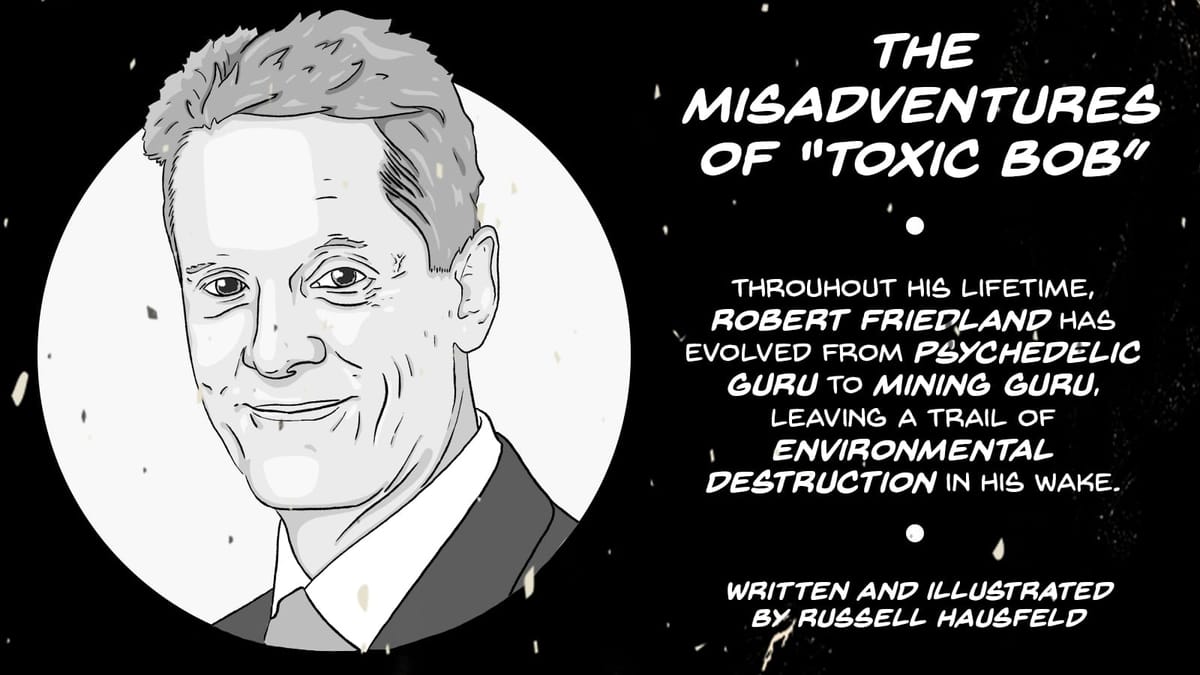
Throughout his lifetime, Robert Friedland has evolved from Steve Jobs’ psychedelic guru to mining guru, leaving a trail of environmental destruction in his wake.
Share
Comic title card: portrait of Robert Friedland beside “The Misadventures of ‘Toxic Bob,’” written and illustrated by Russell Hausfeld
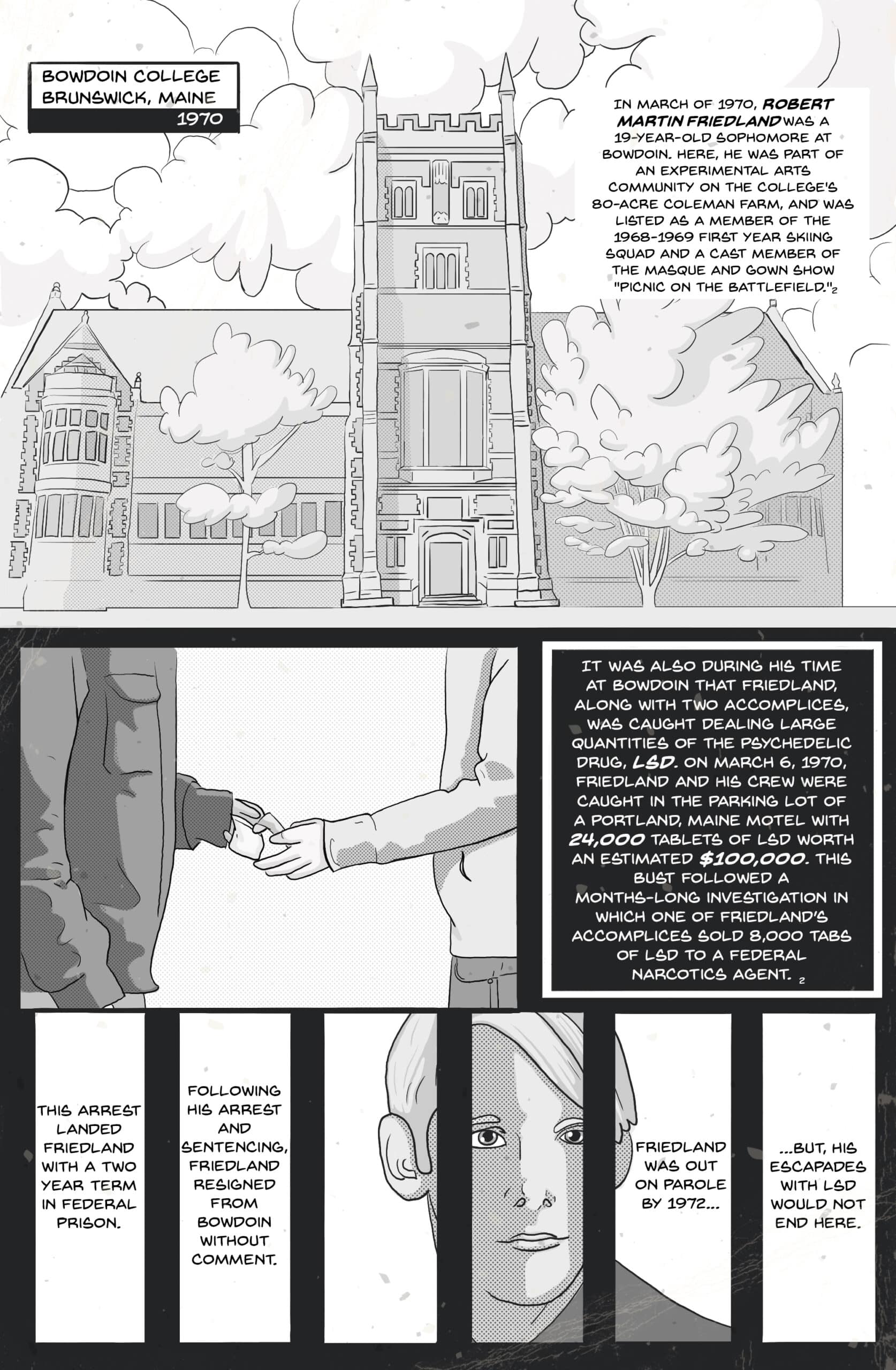
Comic page 1. Bowdoin College, Brunswick, Maine, 1970. In March 1970, Robert Martin Friedland was a 19-year-old sophomore at Bowdoin, part of an experimental arts community on the college’s 80-acre Coleman Farm. While at Bowdoin, Friedland and two accomplices were caught dealing large quantities of LSD: on March 6, 1970, they were caught in the parking lot of a Portland, Maine motel with 24,000 tablets of LSD worth an estimated $100,000, after a months-long investigation in which one accomplice sold 8,000 tabs to a federal narcotics agent. The arrest landed Friedland a two-year term in federal prison. He resigned from Bowdoin without comment and was out on parole by 1972… but his escapades with LSD would not end there.
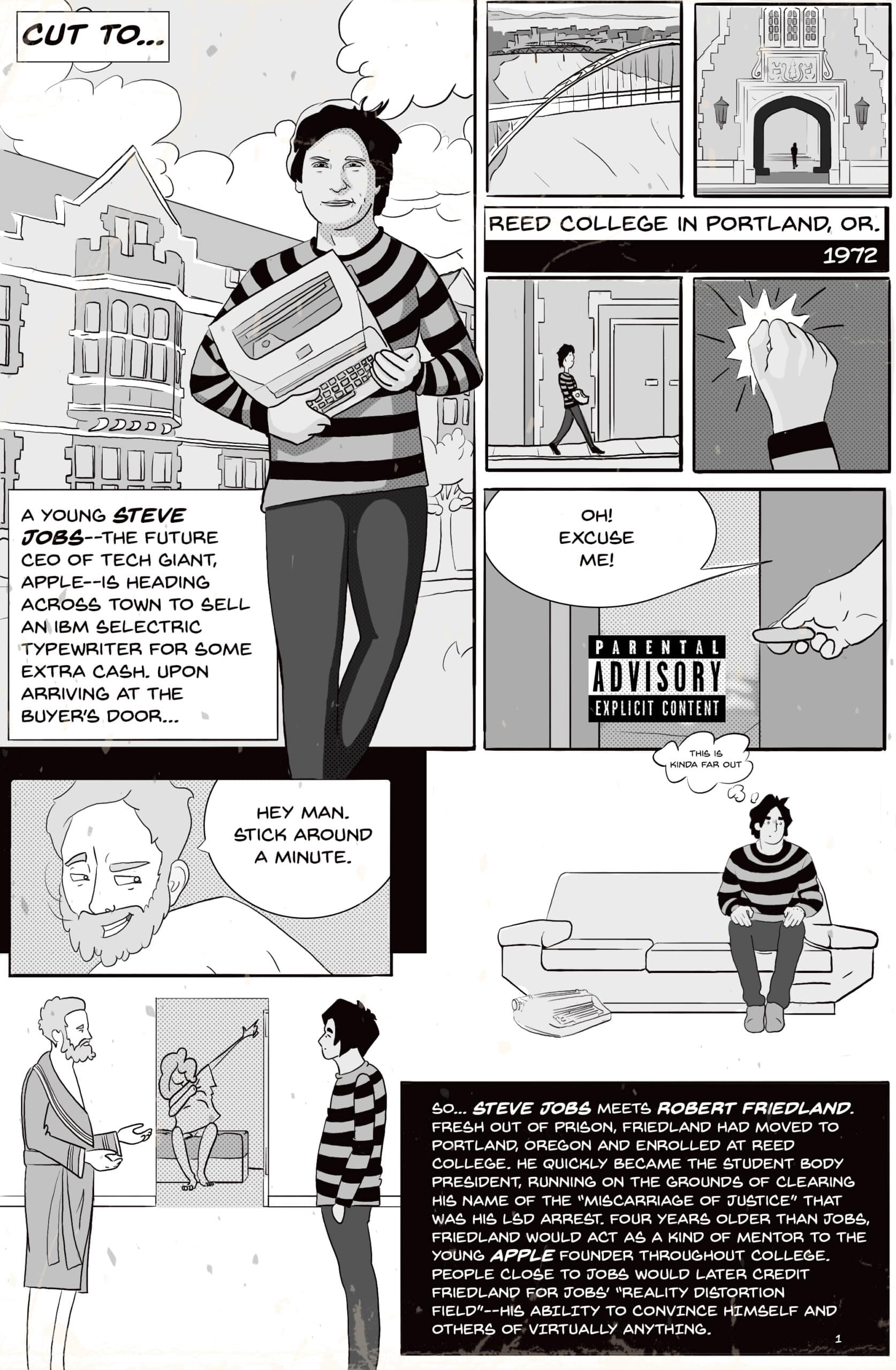
Comic page 2. Cut to Reed College in Portland, Oregon, 1972. A young Steve Jobs, the future CEO of Apple, carries an IBM Selectric typewriter across town to sell it for extra cash. At the buyer’s door he interrupts an explicit scene, covered by a Parental Advisory label, and a bearded man in a bathrobe says, “Hey man. Stick around a minute.” Jobs waits on the couch, thinking, “This is kinda far out.” So Steve Jobs meets Robert Friedland. Fresh out of prison, Friedland had moved to Portland, enrolled at Reed, and quickly became student body president, running on clearing his name of the “miscarriage of justice” that was his LSD arrest. Four years older than Jobs, Friedland acted as a kind of mentor to the young Apple founder; people close to Jobs would later credit Friedland for Jobs’ “reality distortion field,” his ability to convince himself and others of virtually anything.
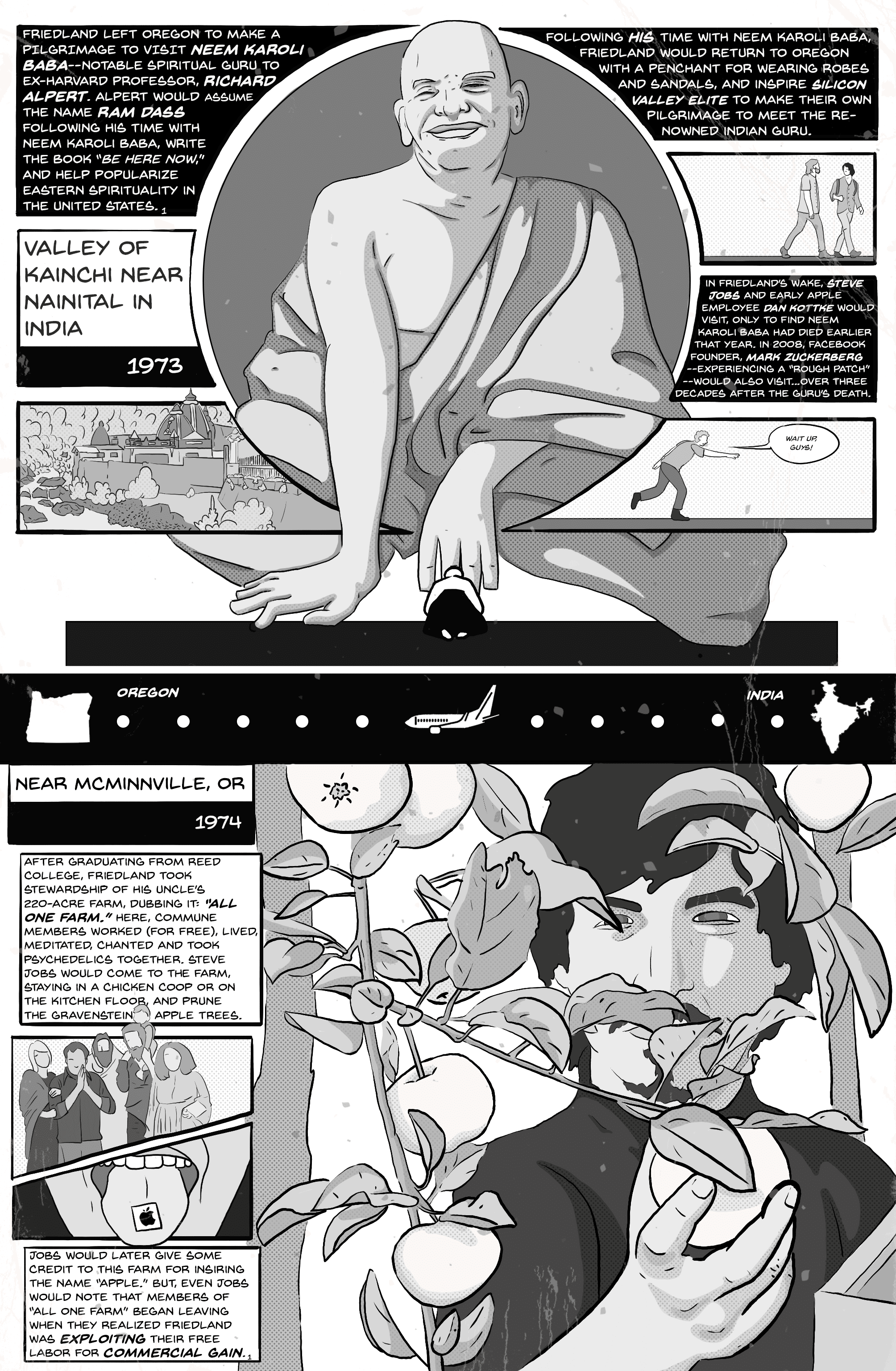
Comic page 3. Valley of Kainchi near Nainital, India, 1973. Friedland left Oregon on a pilgrimage to Neem Karoli Baba, spiritual guru to ex-Harvard professor Richard Alpert, who took the name Ram Dass, wrote “Be Here Now,” and helped popularize Eastern spirituality in the United States. Friedland returned to Oregon with a penchant for robes and sandals and inspired Silicon Valley elites to make their own pilgrimages: Steve Jobs and early Apple employee Dan Kottke visited, only to find the guru had died that year, and in 2008 Mark Zuckerberg visited during a “rough patch.” Near McMinnville, Oregon, 1974: after graduating from Reed, Friedland took stewardship of his uncle’s 220-acre farm, dubbing it “All One Farm,” where commune members worked for free, meditated, chanted and took psychedelics together. Jobs stayed there and pruned the Gravenstein apple trees, and later gave the farm some credit for the name “Apple,” but noted that members began leaving when they realized Friedland was exploiting their free labor for commercial gain.
Comic page 4. Vancouver, British Columbia, 1984: Friedland abandons the robes and sandals and emerges as a maverick in the Canadian mining scene. His Vancouver-based Galactic Resources, bankrolled by the Bank of America and investors in Europe, begins a gold mine in Summitville, Colorado, in 1986. The $222M project was designed by Bechtel, the world’s largest civil engineering company, but Friedland cut many corners to start it in record time. Washington Gold Institute consultant John Dobra: “People were willing to go along with his assumptions. The problem was, his assumptions were usually wrong.” Friedland’s catastrophic mistake was assuming that cheap heap-leach mining, which pours cyanide over heaps of crushed ore on huge liners, would work halfway up a mountain; within days, cyanide began leaking into a nearby creek and the groundwater. Pumping the water back into the heap only raised levels, and more water laced with cyanide and heavy metals leaked into the Alamosa River while Colorado authorities turned a blind eye, fearing a loss of jobs and taxes. Colorado health inspector Jim Horn: “Literally, there was 1,000 to 2,000 pounds of heavy metals leaving the site in dissolved form [daily]. It was like adding half a Buick a day to the Whiteman Fork that flows into the Alamosa.” When the mine was abandoned in 1992, there was no life in the Alamosa River for 17 miles. The EPA has since spent over $150M cleaning up the mine; Friedland, after going to court, paid $20.7M.
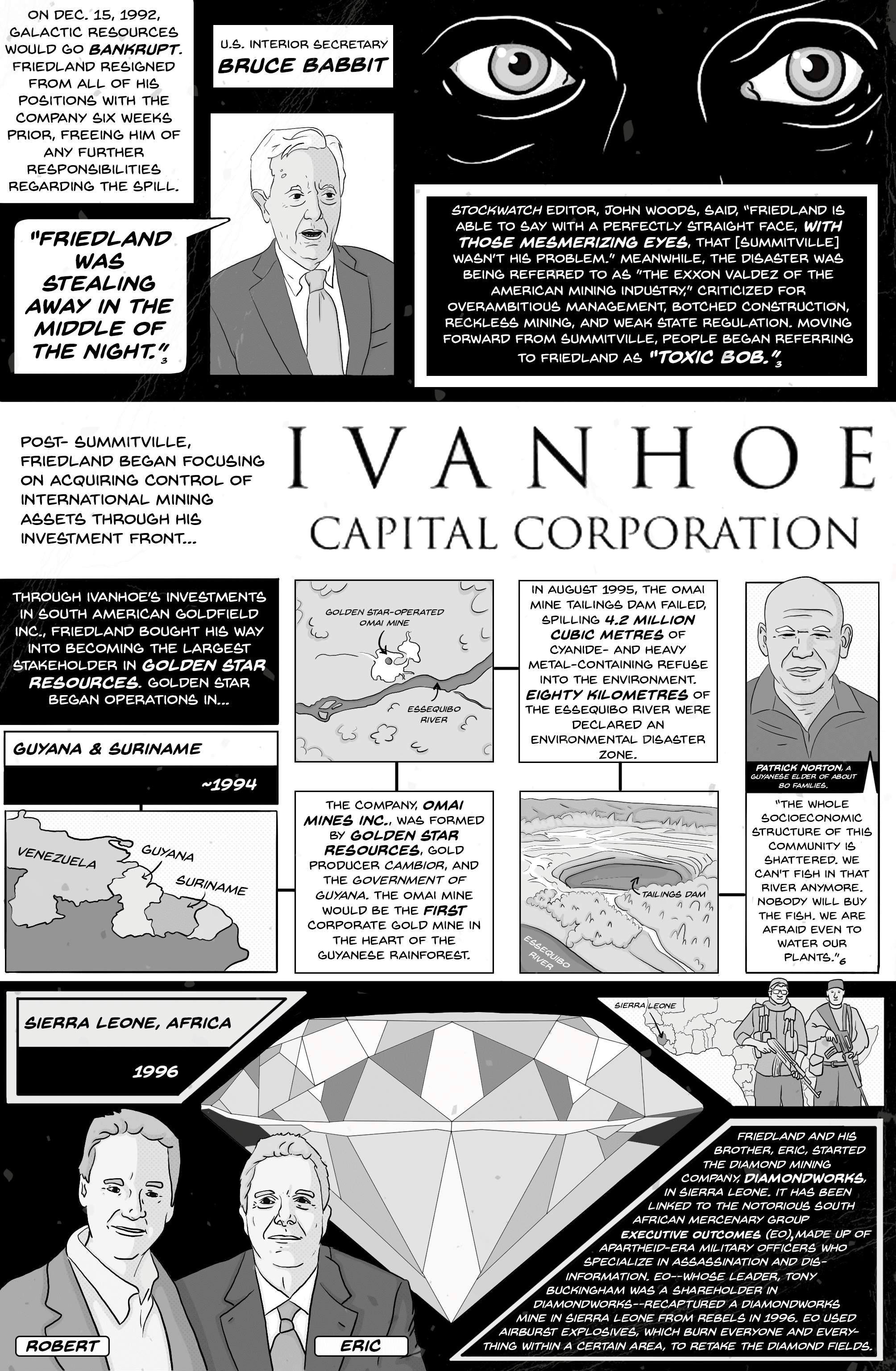
Comic page 5. On December 15, 1992, Galactic Resources went bankrupt; Friedland had resigned all his positions six weeks earlier, freeing him of any further responsibility for the spill. U.S. Interior Secretary Bruce Babbitt: “Friedland was stealing away in the middle of the night.” Stockwatch editor John Woods said Friedland could say “with those mesmerizing eyes” that Summitville wasn’t his problem. The disaster was called “the Exxon Valdez of the American mining industry,” and people began calling Friedland “Toxic Bob.” Post-Summitville, Friedland focused on acquiring international mining assets through Ivanhoe Capital Corporation, becoming the largest stakeholder in Golden Star Resources. In Guyana, around 1994, Omai Mines Inc. (Golden Star, Cambior and the government of Guyana) opened the first corporate gold mine in the Guyanese rainforest. In August 1995 its tailings dam failed, spilling 4.2 million cubic metres of cyanide- and heavy-metal-laden waste; 80 kilometres of the Essequibo River were declared an environmental disaster zone. Guyanese elder Patrick Norton: “The whole socioeconomic structure of this community is shattered. We can’t fish in that river anymore. Nobody will buy the fish. We are afraid even to water our plants.” Sierra Leone, 1996: Robert and his brother Eric started the diamond company DiamondWorks, linked to the mercenary group Executive Outcomes, made up of apartheid-era military officers; EO recaptured a DiamondWorks mine from rebels using airburst explosives.
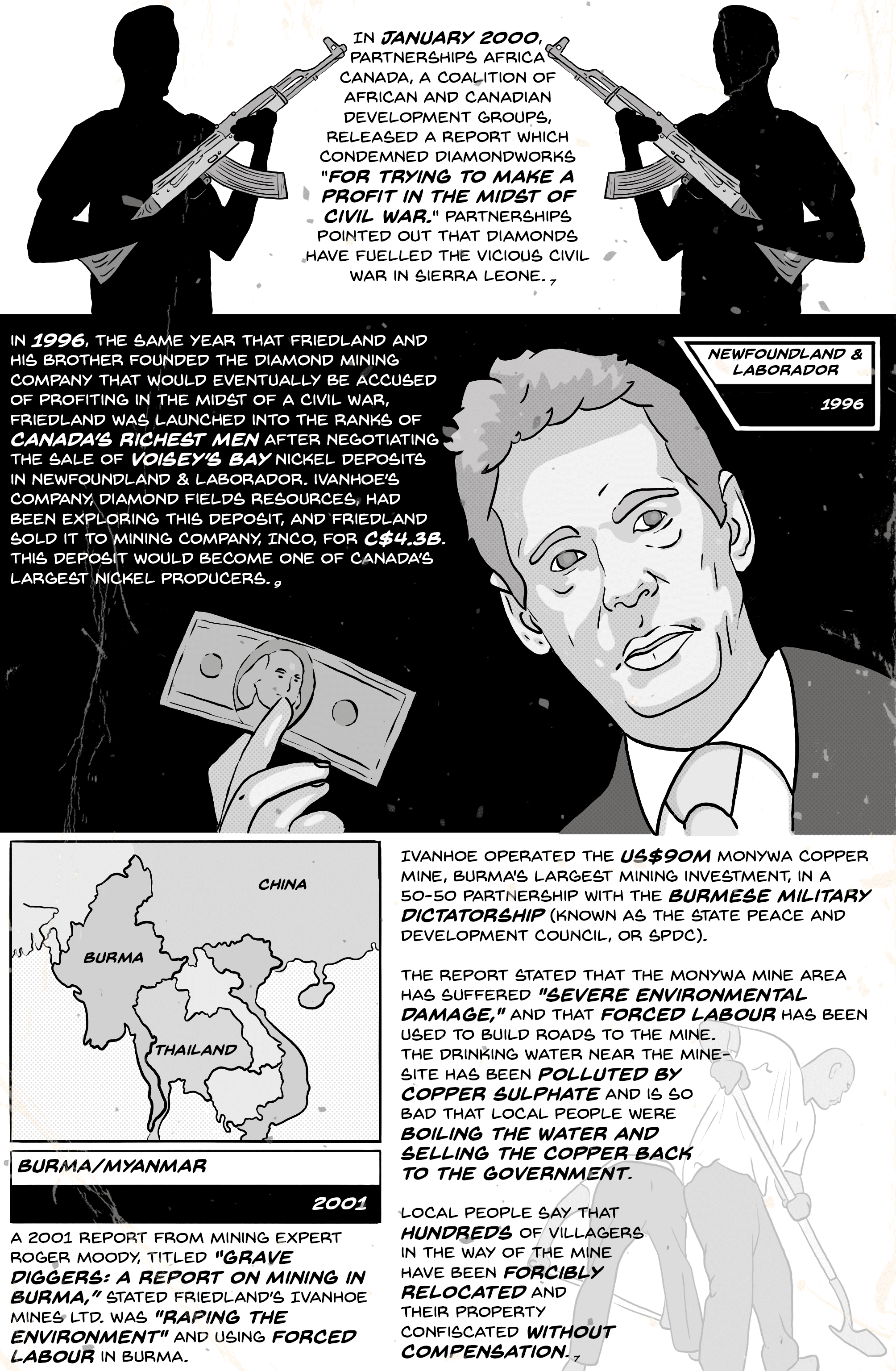
Comic page 6. In January 2000, Partnership Africa Canada released a report condemning DiamondWorks “for trying to make a profit in the midst of civil war,” noting that diamonds had fuelled Sierra Leone’s civil war. Newfoundland and Labrador, 1996: the same year, Friedland joined the ranks of Canada’s richest men by selling the Voisey’s Bay nickel deposit, explored by Ivanhoe’s Diamond Fields Resources, to Inco for C$4.3B; it became one of Canada’s largest nickel producers. Burma/Myanmar, 2001: mining expert Roger Moody’s report “Grave Diggers: A Report on Mining in Burma” said Friedland’s Ivanhoe Mines was “raping the environment” and using forced labour. Ivanhoe ran the US$90M Monywa copper mine, Burma’s largest mining investment, in a 50-50 partnership with the Burmese military dictatorship. The report described severe environmental damage, forced labour used to build roads to the mine, drinking water so polluted by copper sulphate that local people boiled it and sold the copper back to the government, and hundreds of villagers forcibly relocated without compensation.
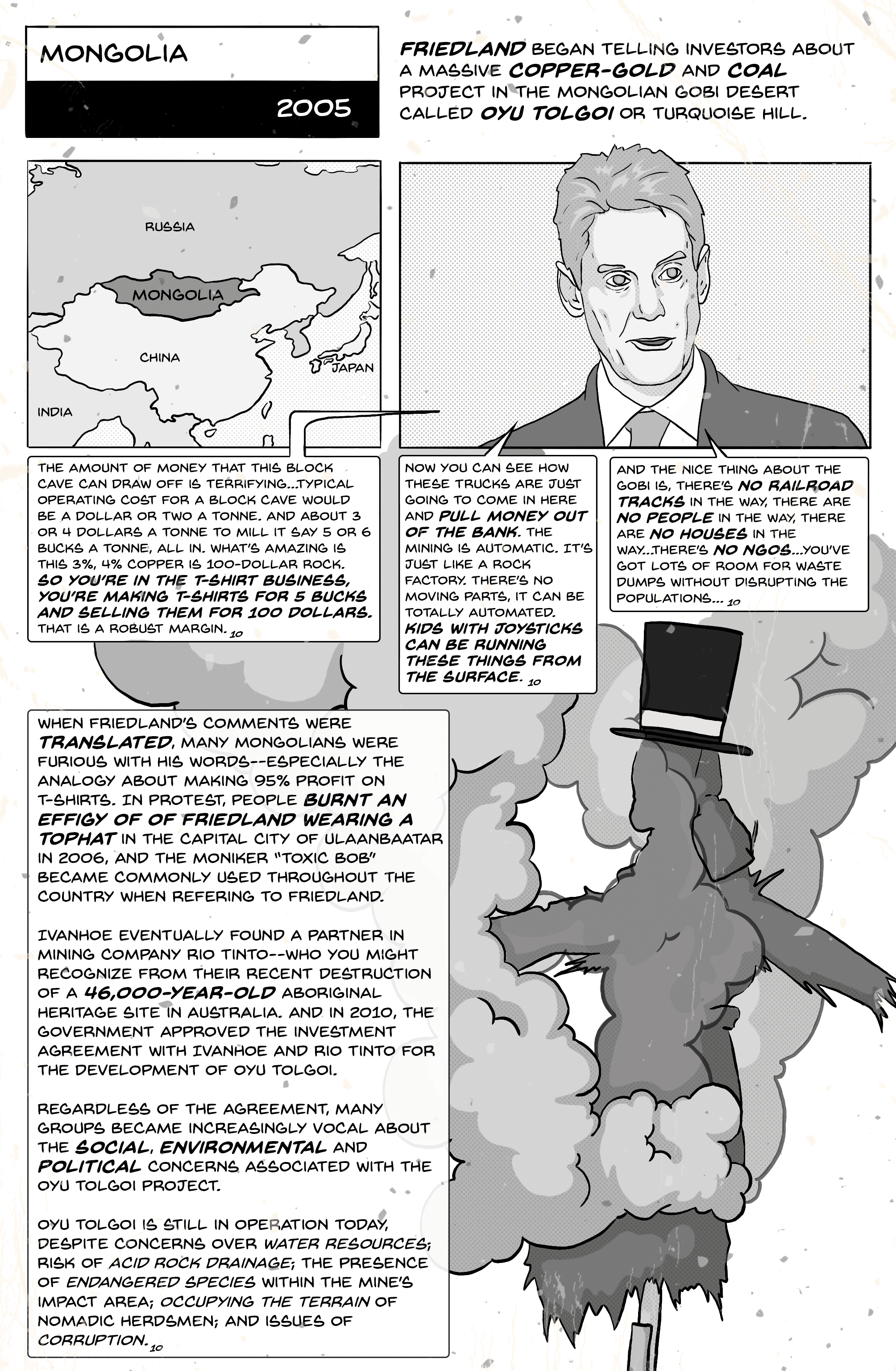
Comic page 7. Mongolia, 2005: Friedland tells investors about Oyu Tolgoi, or Turquoise Hill, a massive copper-gold and coal project in the Gobi Desert. In speech bubbles he says: “So you’re in the T-shirt business, you’re making T-shirts for 5 bucks and selling them for 100 dollars. That is a robust margin”; “Kids with joysticks can be running these things from the surface”; and “The nice thing about the Gobi is, there’s no railroad tracks in the way, there are no people in the way, there are no houses in the way… there’s no NGOs.” When his comments were translated, many Mongolians were furious; protesters burnt an effigy of Friedland wearing a top hat in Ulaanbaatar in 2006, and “Toxic Bob” became a common name for him. Ivanhoe partnered with Rio Tinto, and in 2010 the government approved the investment agreement. Oyu Tolgoi still operates despite concerns over water resources, acid rock drainage, endangered species, the land of nomadic herdsmen, and corruption.
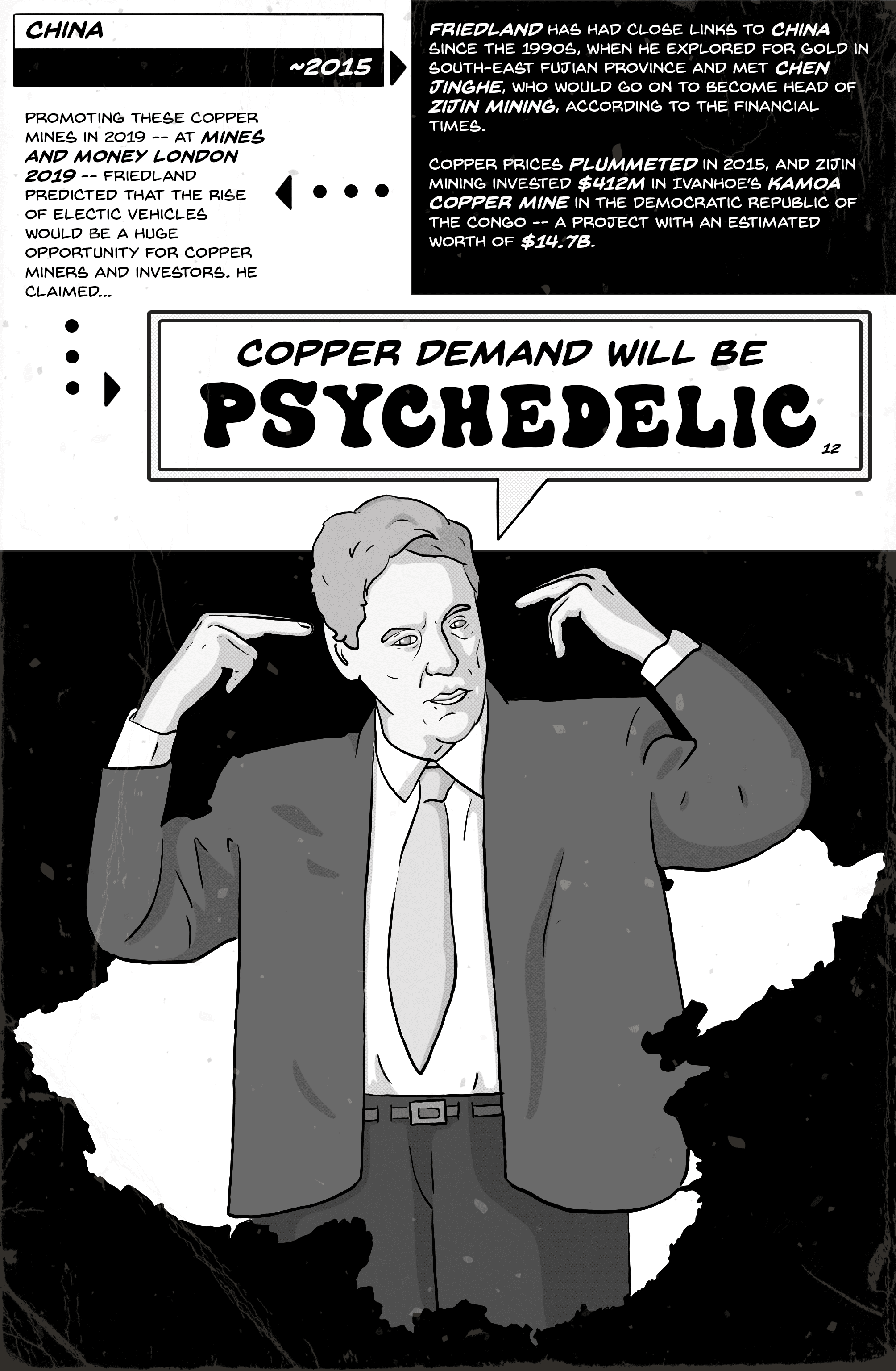
Comic page 8. China, around 2015: Friedland has had close links to China since the 1990s, when he explored for gold in Fujian province and met Chen Jinghe, later head of Zijin Mining. When copper prices plummeted in 2015, Zijin invested $412M in Ivanhoe’s Kamoa copper mine in the Democratic Republic of the Congo, a project worth an estimated $14.7B. Promoting these mines at Mines and Money London 2019, Friedland predicted that electric vehicles would be a huge opportunity for copper miners and investors, and, pointing at his head, claimed: “Copper demand will be psychedelic.”
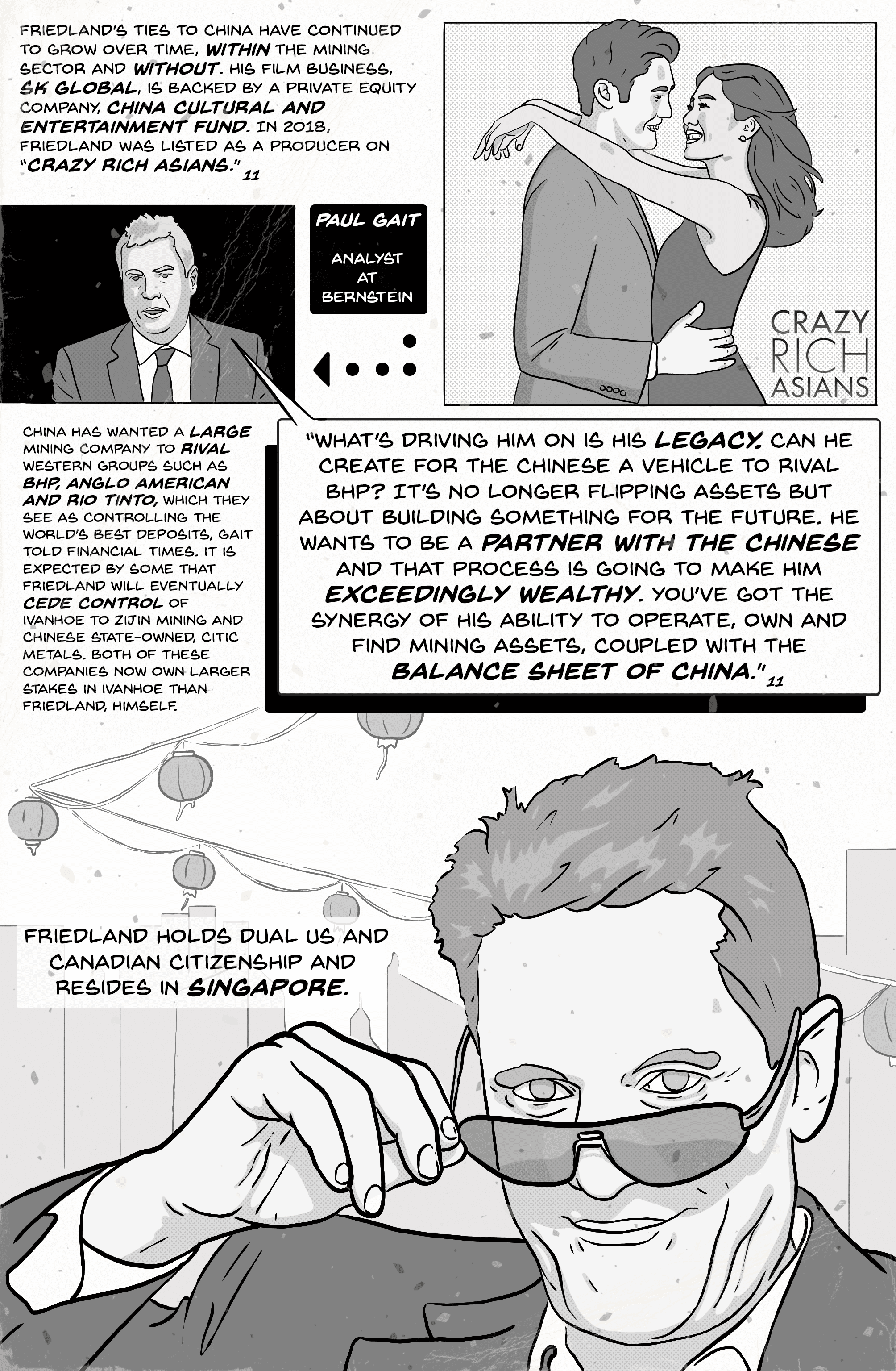
Comic page 9. Friedland’s ties to China have grown within mining and without: his film business, SK Global, is backed by the private equity company China Cultural and Entertainment Fund, and in 2018 he was listed as a producer on “Crazy Rich Asians.” China has wanted a large mining company to rival BHP, Anglo American and Rio Tinto; Zijin Mining and the state-owned CITIC Metals now own larger stakes in Ivanhoe than Friedland himself. Bernstein analyst Paul Gait: “What’s driving him on is his legacy. Can he create for the Chinese a vehicle to rival BHP? … He wants to be a partner with the Chinese and that process is going to make him exceedingly wealthy.” Friedland holds dual US and Canadian citizenship and resides in Singapore.
Comic page 10. $1.5 billion: Robert Friedland’s 2021 net worth. Steve Jobs, co-founder of Apple: “It was a strange thing to have one of the spiritual people in your young life turn out to be, symbolically and in reality, a gold miner.” John Woods of Canadian Stockwatch: “[Friedland] thrives in countries that have dodgy governments that are reputed to be corrupt.” John Capel, executive director of the Bench Marks Foundation: “Friedland’s mines have left a litany of human and plant destruction. Where he leads, community dislocations and expensive clean-ups are the order of the day.” Sources: 1. “Steve Jobs: The Exclusive Biography” by Walter Isaacson. 2. “Bowdoin’s Toxic Son” by Charles Cubeta. 3. “The Ugly Canadian” by Roger Moody. 4. “Robert Friedland and the Former Summitville Mine, Colorado Fact File” by Ivanhoe Capital. 5. “The Road to Summitville, a Gold Mining Debacle” by Rick Young and Dan Noyes. 6. “Cyanide Spill in Guyana River Harms Indians, Fish Industry” by Carol Rosenberg. 7. “March 2001: ‘Toxic Bob’ Wastes Burma” by Asad Ismi. 8. “Executive Outcomes: A Corporate Conquest” by Khareen Pech. 9. Robert Friedland’s Ivanhoe Capital founder’s business profile. 10. “Mining Mongolia: Ivanhoe, T-shirts, NGOs, and WikiLeaks” by MiningWatch. 11. “Robert Friedland, China and the Rush for Copper in the DRC” by Henry Sanderson. 12. “Mines and Money London: ‘Copper Demand Is Going to Be Psychedelic!’” by Daniel Brightmore. 13. “BMF: Rich People in Glass Houses” by Bench Marks Foundation.